The family of Queen Victoria
Despite the Queen's strong distaste of being pregnant and childbirth, she was to become a prolific mother, producing nine children. The eldest, Victoria, Princess Royal, known in the family as Vicky and later to become German Empress was born in 1840, she was followed by a male heir to the throne, Albert Edward, Prince of Wales, known as Bertie in the family, in 1841 (later to reign as Edward VII).
Queen Victoria with her family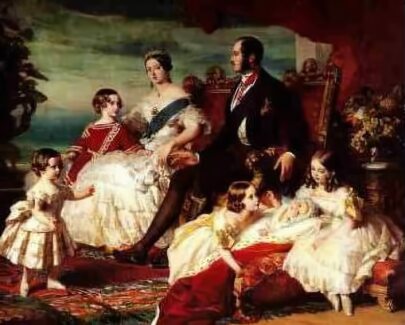
Two years later the Queen gave birth to Alice, destined to become Grand-Duchess of Hesse-Darmstadt. There followed a second son, Alfred, known in the family as Affie'who was born in 1844 and created Duke of Edinburgh, then Helena, Lenchen to her relations, Louise in 1848, Arthur, who became the Duke of Connaught, in 1850, Leopold in 1853, later created Duke of Albany, during his birth the Queen received "blessed chloroform" for the first time, Leopold suffered from haemophilia, the first incidence of many of the disease in Victoria's family. The Queen's last child, Beatrice, was born in 1857.
The Queen had for a long time cherished a love affair with Scotland, she adored the wild Highland scenery, which appealed to her emotional nature. Albert also greatly liked Scotland, since the country reminded him of his German homeland. In 1852, Victoria and Albert acquired their Scottish retreat, Balmoral Castle with money left to her in the will of the wealthy and eccentric John Camden Nield. The couple were to visit their Scottish home every summer.
The Queen's third son Leopold suffered from haemophilia and was to become a constant source of anxiety to his parents. There had been no former incidence of this disease in the Hanoverian family or that of Saxe-Coburg-Gotha, the mutation which caused it is thought to have arisen in Victoria's father, the Duke of Kent. The disease generally manifests itself only in men, whereas women are known to be carriers. The Queen's daughters Alice and Beatrice were to spread haemophilia into many of the royal families of Europe, including Russia, Spain, Prussia, Battenberg and Hesse.
Victoria and Albert lead an exemplary family life which regained the crown's respect after the scandalous behaviour of her uncles. Albert introduced many of the customs of his German homeland to Britain, perhaps the most famous of these being the Christmas tree.
Bertie, their eldest son and heir to the throne, did not inherit his father's considerable intelligence. He was nevertheless subjected to a punishing system of education, devised by his father's mentor Baron Stockmar, which singularly failed in its object of producing the perfect King. Bertie, overworked far beyond his abilities or inclinations, reacted in rages, for which he was punished and forced into further gruelling study.
The Queen instituted the Victoria Cross, the highest single award for valour, during the Crimean War. It was given to ordinary soldiers as well as officers and proved a popular innovation. Albert's project, the Great Exhibition of 1851, designed to show that Britain leads the world in scientific and industrial knowledge and promote trade, proved to be a great success. "Albert's dearest name is immortalized with this great conception," wrote his doting wife "his own, and my dear country showed she was worthy of it".
Victoria and Albert saw the birth of their first grandchild in 1857, when their daughter Vicky, who had married the heir to the Prussian throne, gave birth to the future Kaiser Wilhelm II. The labour had been difficult, resulting in the child being born with a damaged and withered arm. He was eventually to rule over a rival power and was to be ultimately responsible for the outbreak of the First World War, which shattered Albert's vision of world peace and free trade.
Victoria and Albert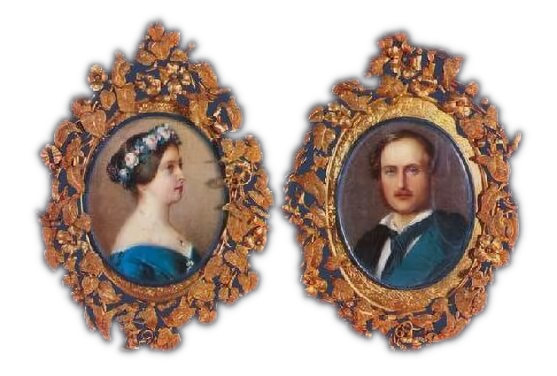
The Queen's relations with her mother, the Duchess of Kent, had steadily improved under the benign auspices of Albert and the Duchess was eventually to become a doting grandmother to Victoria's children and was very fond of her nephew and son-in-law. The Queen's mother died on 16 March, 1861, Victoria was with her at the end. She was buried at the Duchess of Kent Mausoleum at Frogmore, Windsor Great Park. The Queen was greatly distressed by her loss and mourned her sincerely if obsessively.
The Death of Albert
Bertie was not turning out to be the prodigy that his father had ardently envisioned. While stationed at the Curragh, an army training camp in Ireland, he had indulged in a liaison with a young actress named Nellie Clifton. News of the affair was leaked to the newspapers which caused his father "the greatest pain I have ever yet felt in this life." Distraught over the matter and vastly overworked, Albert related it to the Queen, informing her she was not to hear "the disgusting details."
The effect the incident had on Albert was catastrophic. He sent his son an extremely long letter on the subject. He went on to visit Bertie to further drive the message home. Bertie was reassuringly contrite, but Albert, distraught with sorrow, continued to worry and fret over the matter.
Tragedy struck in 1861 when Albert contracted typhoid fever, possibly from the archaic state of the drains at Windsor Castle. The illness struck a frame already weakened by conscience overwork and worry and the Prince did not have the strength to survive it. He died, his wife and family gathered around him, on 14th December 1861. Victoria hysterically blamed the Prince of Wales and the episode at the Curragh for his father's death. "That boy," she wrote to her daughter Vicky in Germany, "I never can, or ever shall look at him without a shudder".
The devastated Queen, whose adoration and dependence on her husband had been immense, suffered a breakdown. She had come to rely on her husband's advice and guidance in every aspect of her life, to such an extent that she now felt lost. "The world is gone for me, my life as a happy one is ended," she wrote dejectedly. Wrapped in self-pity she became reclusive and refused to carry out state duties or appear in public, leading to direct criticism of the monarchy. She incarcerated herself at her homes of Osborne, on the Isle of Wight or Balmoral, in the Highlands of Scotland.
As the years passed the Queen's sense of loss and grief for her husband did not abate. Never an easy character, she stubbornly ignored calls for her to appear in public more often, which provided ammunition for republicans. The scandal threatened to engulf her when she formed an emotional attachment to one of her Highland servants, John Brown, many referred caustically to the Queen as Mrs Brown, adverse comments about her behaviour began to appear in the press and there were calls for her to stand down in favour of the Prince of Wales. There was unlikely to be anything in the relationship other than the companionship the lonely Queen craved.
Victoria's Prime Ministers
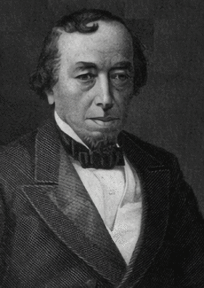
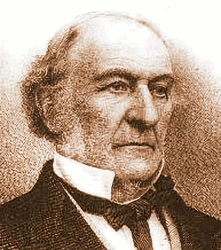
In the 1870s, Victoria's then Prime Minister, William Ewart Gladstone, tried to coax the obstinate Queen out of her premature retirement, it was not an easy task, their relationship, never good, went downhill rapidly. Benjamin Disraeli, the other great Prime Minister of the age, developed a more effective method of handling her by flattering her vanity and avoided clashing with her views head-on, he was consequently much preferred and she began again to attend state functions and opened the Albert Memorial in 1876.
Disraeli also secured the title of Empress of India for the Queen, which was bestowed on her in 1876. Her friendship with him was so strong that during his last illness the Queen offered to visit him. Disraeli reacted with his usual good humour when he responded by saying it would be better if she didn't, as she would only ask him to "carry a message to Albert". The great statesman died in 1881.
William Ewart Gladstone
The Later Years
Victoria and her grandchildren following the established Hanoverian pattern, relations with her profligate eldest son and heir, Bertie, were never good. The Queen did not approve of his lifestyle, his many mistresses or his love of horse racing, which she considered incurred censure of the monarchy and brought disrepute on the institution. She spoke of his eventually ascending the throne as "too awful" to contemplate. Nothing was done to prepare him for his future role as King and not until he was a grandfather himself would the Queen even allow him access to cabinet papers.
Queen Victoria with her grand children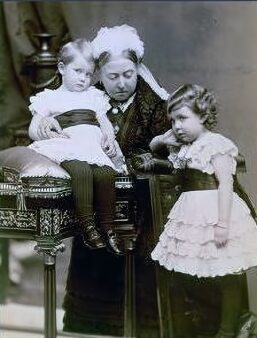
Victoria was to become England's longest-reigning monarch, she reigned for sixty-four years, longer even than her grandfather, George III, during which Britain became the most powerful nation on Earth. Through the descendants of her 42 grandchildren, many of the occupants of the current thrones of Europedescend from Victoria and Albert and she became known as the Grandmother of Europe.
Victoria and Albert's eldest grandson, Wilhelm, the son of Victoria, Princess Royal and Prince Frederick of Prussia became Kaiser Wilhelm II of Germany. His sister, Princess Sophie of Prussia, through her marriage to King Constantine I of Greece in 1889, became Queen of the Hellenes. All three of Sophie's sons, George II, Alexander (whose daughter Alexandra married Peter II of Yugoslavia), and Paul reigned as kings of Greece. Paul and Frederica's (the granddaughter of Paul's uncle Wilhelm II) daughter Sofia married Juan Carlos I of Spain and they became monarchs of Spain in 1975. Paul and Frederica's son, ex-king Constantine II, is married to the former Princess Anne-Marie of Denmark. Sophie's daughter, Princess Helen of Greece (1896-1982), was later Queen of Romania, through her marriage to her second cousin, Carol II (15 October 1893 - 4 April 1953) and the mother of King Michael of Romania.
Edward VII's youngest daughter Maud occupied the throne of Norway after her marriage to her maternal cousin Prince Carl of Denmark, later King Haakon VII of Norway (1905-1957). Alice's fourth daughter Alix of Hesse became Tsarina of Russia and was assassinated by the bolsheviks with her husband Tsar Nicholas II and their five children in an Ekaterinburg cellar in July 1918. Alice's daughter Victoria was the mother of Queen Louise of Sweden, who became the second wife of future Gustav VI Adolf of Sweden in 1923. Princess Victoria's oldest daughter, Alice, was the mother of Prince Philip of Greece who is married to Elizabeth II, the present queen of Great Britain.
Victoria's granddaughter, Princess Marie of Edinburgh, the daughter of Alfred, Duke of Edinburgh, became Queen of Romania after marrying Ferdinand of Romania in 1893, their son Carol was married to Vicky's granddaughter, Helen of Greece. Marie's oldest daughter Elisabeth married George II of Greece, but the couple had no descendants. Marie's second daughter, also called Marie, married King Alexander I of Yugoslavia in 1922. Following her husband's assassination in 1934, her oldest son became Peter II, the last reigning king of Yugoslavia.
Arthur Duke of Connaught's daughter Princess Margaret of Connaught married in 1905 to Prince Gustaf Adolf of Sweden (1882-1973) - later King Gustav VI (1950-1973). Their son Prince Gustav Adolf, Duke of Västerbotten (1906-1947) was the father of King Carl XVI Gustav, the present King of Sweden. Carl Gustav's mother was Princess Sibylla of Saxe-Coburg and Gotha, daughter of Leopold Duke of Albany's son, Charles Edward, Duke of Saxe-Coburg-Gotha, providing a further descent from Victoria to the House of Sweden. Margaret Queen of Sweden's daughter, Ingrid of Sweden (28 March 1910 - 7 November 2000) became Queen of Denmark from 1947 until 1972 as the wife of King Frederick IX. Her daughter, Queen Margrethe II of Denmark is the present occupant of the Danish throne.
Princess Victoria Eugènie of Battenberg, the daughter of Victoria's youngest child Princess Beatrice married King Alfonso XIII of Spain, their son, Don Juan Carlos de Borbon, Count of Barcelona (1913-1993) was the father of King Juan Carlos I, the present King of Spain.
Victoria's reign witnessed a multitude of changes, she was the first British monarch to travel by train or be photographed, generally dressed as a widow and looking rather severe and glum. In 1897, Victoria celebrated her Diamond Jubilee, driving to a service of thanksgiving at St. Paul's Cathedral in an open landau, so that she could be seen by the people. Crowds flocked to see her.
Queen Victoria lived to witness the dawn of the twentieth century. Towards the end of the year 1900, it became clear that the Queen's health was declining. The opening entry in her diary for 1901 reads "Another year begun and I am feeling so weak and unwell that I enter upon it sadly." She had an inherent tendency to gain weight easily and had grown successively heavier over the years, at the end of her life her waist measured 46 inches. By the second week of January, the Queen's physicians noted that she had begun to exhibit signs of cerebral degeneration and had suffered a mild stroke.
Victoria's family were summoned to Osborne House on the Isle of Wight and a public statement was issued, over the following few days, the Queen drifted peacefully into a coma. She breathed her last, supported by her grandson, the Kaiser and Bertie, Prince of Wales, with her children and many of her grandchildren gathered around her on the 22nd of January 1901.
Her coffin was placed on a dais at Osborne House and covered with her coronation robes, the small diamond crown she often wore and the garter upon a pillow. The Prince of Wales once remarked that his mother "loved funerals" and she left a detailed memorandum on how she wished to be buried.
After lying in state at Osborne, the Queen's body was carried to the mainland on the 1st of February aboard the Alberta. In the last stages of the journey, the coffin was placed on a gun carriage at Windsor, but the horses broke their harness, causing it to be dragged to St. George's Chapel by a naval Guard of Honour. She was reunited at last alongside Albert at the mausoleum she had built for them both to lie in, at Frogmore, Windsor. Her death marked the end of an era.


Queen Victoria PreviousNext Sophia Dorothea of Celle